

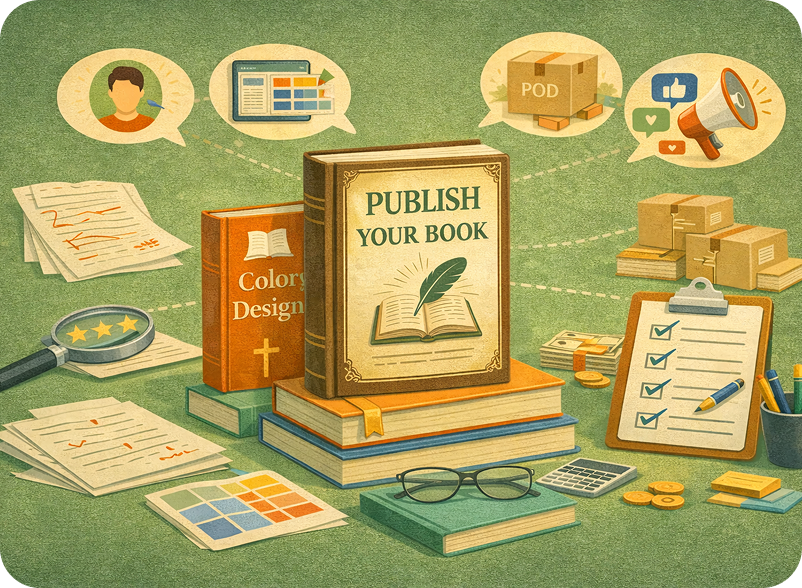
How much money do you really need to publish a book in 2026? The answer depends on your manuscript, book format, editing requirements, cover design, and marketing strategy. Some authors publish through Amazon Kindle Direct Publishing (KDP) with almost no upfront spending, while others invest thousands of dollars in professional publishing services.
This guide breaks down the cost of self-publishing a book, compares DIY and professional options, and helps you estimate a realistic budget before releasing your first title.
These are broad planning examples, not guaranteed market rates. Your actual costs may be lower or higher depending on your book and service providers.
Explore Amazon KDPHow Much Does It Cost to Self-Publish a Book?
In 2026, a practical self-publishing budget can range from virtually nothing for an author who handles every task independently to several thousand dollars for a book produced with professional editing, custom cover design, formatting, and marketing.
There is no universal price because self-publishing is a collection of services rather than a single product. You can pay for only the tasks you cannot perform yourself, or outsource most of the production process.
| Publishing approach | Illustrative budget | Best for |
|---|---|---|
| DIY publishing | $0–$200 | Authors with editing, design, and formatting skills |
| Lean hybrid approach | $200–$800 | Authors who outsource a few important tasks |
| Professional production | $800–$3,000 | Authors seeking several professional services |
| Premium publishing project | $3,000–$7,000+ | Complex books, extensive editing, illustrations, or substantial marketing |
These ranges are illustrative budgeting scenarios, not verified industry averages. They exclude unusual expenses such as extensive research, travel, translation, or large-scale advertising campaigns.
What is the cheapest way to publish a book?
The cheapest approach is to write and revise the manuscript yourself, use free formatting software, create your own cover, and publish through a platform that does not charge an upfront publishing fee. For eligible titles, Amazon KDP offers this option.
However, free publishing does not necessarily mean a book is ready for readers. Proofreading, a readable layout, an effective cover, and accurate product information are important even when your budget is limited.
Self-Publishing Costs in 2026: A Detailed Breakdown
Before choosing a budget, understand which expenses are optional, which may be worth outsourcing, and which depend on the format you select.
1. Manuscript Editing: $0–$1,500+
Editing is often one of the most important investments in a self-published book. The price depends on word count, manuscript condition, genre, turnaround time, and the type of editing required.
- Self-editing: $0 in service fees, although it requires considerable time and attention.
- Proofreading: A final review for spelling, punctuation, grammar, and minor errors.
- Copyediting: A closer review of language, consistency, clarity, and style.
- Developmental editing: Broader feedback on structure, argument, plot, pacing, and organization.
These services are not interchangeable. A short, well-revised nonfiction guide may need less work than a long novel requiring substantial structural changes. Request quotes based on your manuscript’s word count and needs.
2. Book Cover Design: $0–$800+
Your cover influences how readers perceive the book before they read a single page. It should be legible at thumbnail size, suitable for your genre, and consistent with the content.
| Cover option | Budget estimate |
|---|---|
| DIY cover using free tools | $0–$50 |
| Premade cover template | $30–$150 |
| Custom professional cover | $150–$800+ |
These are planning estimates only. Illustration-heavy covers, complex designs, and premium design services can cost more. For print books, confirm whether the quote includes the full cover, spine, and back cover.
3. Book Formatting and Interior Layout: $0–$500+
Formatting prepares your manuscript for comfortable reading and correct production. Ebook formatting and print layout have different requirements.
- DIY ebook formatting: Free tools such as Kindle Create may be sufficient for straightforward books.
- DIY print formatting: Word processing or book-layout software can work for simple text-heavy titles.
- Professional formatting: Useful for complex tables, illustrations, footnotes, academic material, or intricate page layouts.
For print books, page dimensions, margins, image resolution, and bleed settings must meet the platform’s specifications. Always preview the final file before publication.
4. ISBN and Copyright-Related Expenses: $0–Variable
ISBN requirements depend on your format, country, and distribution plan. Kindle ebooks do not require an ISBN on KDP. Eligible paperback and hardcover editions may use a free KDP ISBN, while authors who want their own ISBN can purchase one from the appropriate national agency.
For example, ISBN pricing and eligibility in the United States differ from those in other countries. Do not assume that one country’s ISBN price applies internationally.
Copyright protection and registration rules also vary by jurisdiction. Registration, legal advice, permissions, and licensing can create additional costs, but they are not automatically required expenses for every book.
5. Proof Copies and Author Copies: $0–Variable
For print books, you may want to order a proof or author copy to inspect paper quality, typography, margins, cover colors, and overall appearance. The amount depends on printing specifications, shipping, taxes, and your location.
Ordering copies is optional, but reviewing a physical copy can help catch issues that are difficult to spot on screen.
6. Book Marketing: $0–$1,000+
Marketing costs vary enormously. You can promote your book through free channels or pay for advertising, launch support, promotional services, and creative assets.
- Author website and organic search content.
- Email newsletter and reader community.
- Social media content and interviews.
- Amazon Ads, where available and appropriate.
- Promotional graphics, launch campaigns, and other paid services.
Set a budget you can afford to lose, especially when publishing your first book. Track actual sales and royalties instead of assuming that advertising spend will automatically generate a profit.
7. Software, Research, and Other Expenses: $0–Variable
You may need writing software, image licenses, research materials, specialist fonts, translation, or accessibility support. Some authors already own the tools they need, while others may have substantial additional requirements.
Check commercial-use licenses carefully if you use stock images, templates, fonts, or AI-assisted production tools. Your right to publish a resource depends on its license and applicable rules.
How Much Does Amazon KDP Cost in 2026?
Amazon Kindle Direct Publishing allows authors to publish eligible ebooks and print books without paying a standard upfront platform fee. You upload your files, enter book details, select pricing, and submit the title for review.
KDP also provides free tools for tasks such as ebook formatting and cover creation. This can make it a practical choice for beginners who want to keep initial spending low.
Kindle ebook publishing costs
A Kindle ebook has no physical printing cost. Your main potential expenses are manuscript editing, cover design, formatting, and marketing. KDP offers different ebook royalty plans subject to eligibility and marketplace requirements.
Paperback publishing costs
Paperback production costs depend on factors including page count, trim size, ink type, paper options, and marketplace. KDP calculates the applicable printing cost and uses it when calculating royalties.
For example, Amazon’s published US pricing table lists a fixed printing cost of $1 plus $0.012 per page for a regular-trim black-ink paperback in the applicable 110–828-page range. A 300-page book under those specifications would have an estimated printing cost of $4.60 per copy. Other specifications may produce different costs. Check the official paperback printing cost table.
Hardcover publishing costs
Hardcover printing can cost more than paperback printing. The price depends on page count, trim size, ink, and marketplace. KDP calculates the printing charge for your selected specifications and deducts it when calculating royalties. Review official hardcover printing costs.
What about KDP royalties?
Your royalty is not the same as your profit. You must account for production costs, professional services, advertising, taxes, and other expenses you paid to create and promote the book.
For Kindle ebooks, KDP has 35% and 70% royalty plans with specific eligibility requirements. For print books, royalty calculations take the applicable rate and printing costs into account. Use the official KDP pricing and royalty guidance to check current terms.
Self-Publishing Cost Calculator for 2026
Estimate your initial publishing budget by selecting the services you plan to use. The default figures are editable planning estimates, not fixed industry prices. Enter zero for a service you will handle yourself.
Estimated upfront budget: $915.00
10% contingency: $91.50
Suggested budget including contingency: $1,006.50
The calculator adds the expenses you enter and a 10% contingency. It does not estimate future sales, taxes, royalties, or ongoing business costs.
How to interpret your estimate
- Under $200: A DIY-focused project with very limited paid services.
- $200–$800: A lean approach with selected professional help.
- $800–$3,000: A budget that may cover several professional services.
- Over $3,000: Consider whether the project requires extensive editing, illustration, translation, or a larger launch campaign.
These ranges are rough planning categories. A complex illustrated book can exceed them, while a straightforward ebook may cost much less.
Example Budgets for Different Types of Books
The right budget depends on what you are publishing. A text-only ebook has different needs from a full-color children’s book or a heavily illustrated cookbook.
| Book type | Potential cost drivers | Budget strategy |
|---|---|---|
| Short nonfiction ebook | Proofreading, cover, formatting | Use free tools and spend selectively on editing. |
| Full-length novel | Developmental editing, copyediting, cover | Prioritize manuscript quality and genre-appropriate design. |
| Business or educational book | Fact-checking, tables, layout, permissions | Budget for accuracy and clear formatting. |
| Children’s picture book | Illustrations, color layout, cover | Request quotes for the complete illustration package. |
| Cookbook | Photography, recipe testing, color printing | Calculate print costs before choosing a retail price. |
| Journal or planner | Interior design, page count, cover | Check print specifications and production costs carefully. |
How to Self-Publish a Book on a Budget
You do not have to spend thousands of dollars to get started. A sensible budget focuses on the improvements that matter most to readers and avoids paying for unnecessary services.
1. Use Free Publishing Tools
Explore free writing and formatting tools before buying specialist software. Amazon KDP offers resources to help authors prepare files, create covers, and preview ebooks. Start with the official KDP publishing guide.
2. Learn to Format Simple Books Yourself
For a text-heavy novel or straightforward nonfiction ebook, self-formatting may be manageable. Follow the platform’s requirements and test the result carefully. For complex layouts, compare the cost of learning specialist software with hiring an experienced formatter.
3. Spend Strategically on Editing
Revise the manuscript yourself before sending it to an editor. Use feedback from trusted beta readers, check consistency, and resolve obvious problems first. A cleaner manuscript may require less corrective work, although the savings depend on the project and editor.
4. Compare Quotes Before Hiring
Ask potential service providers for a clear scope of work, turnaround time, revision policy, and examples of relevant projects. Compare like-for-like services rather than choosing solely on price.
5. Avoid Buying Services You Do Not Need
New authors may be offered expensive publishing packages that bundle editing, distribution, publicity, and other services. Review every component and determine whether you actually need it. KDP does not require you to purchase a publishing package to upload a standard eligible book.
6. Keep Advertising Separate from Production Costs
Book production is a one-time or occasional expense, while advertising can continue month after month. Set a separate marketing limit and evaluate results before increasing it. Do not assume that more spending automatically leads to more profitable sales.
7. Verify Rights and Licenses
Do not use images, fonts, illustrations, or text simply because they are easy to download. Confirm that the relevant licenses allow your intended commercial use. Resolving rights problems after publication can be expensive and disruptive.
How Long Does It Take to Earn Back Your Self-Publishing Costs?
Breaking even depends on your total investment and how much you earn per sale. A book that costs $500 to produce needs fewer profitable sales to recover its cost than a book that costs $3,000.
Use this simple formula:
Round up to the next whole sale. For a more accurate business estimate, include recurring expenses, advertising, refunds where applicable, and taxes separately.
Example break-even calculation
Suppose your total publishing budget is $900 and your average royalty after applicable platform deductions is $3 per sale.
- Initial publishing budget: $900
- Average royalty per sale: $3
- Sales needed to recover the initial budget: 300
This is a hypothetical example, not a prediction of sales. Actual royalties may vary by format, price, marketplace, delivery or printing costs, and other factors. If you pay for advertising, calculate whether those additional costs change the break-even point.
Is Self-Publishing Worth the Cost in 2026?
Self-publishing can be worthwhile if you value creative control, want to reach readers directly, and are prepared to manage the production and promotion process. KDP lowers the financial barrier to publication because standard uploading and listing do not require an upfront fee.
However, there is no guarantee that your book will sell enough copies to recover its production costs. The best investment depends on your audience, the quality of the manuscript, your competition, and the value readers see in the finished book.
For a first-time author, a sensible strategy is to start with a clear budget, invest in the areas where professional help adds the most value, and avoid taking on debt based on uncertain future royalties.
Frequently Asked Questions
Can I self-publish a book for free in 2026?
Yes. You can publish an eligible book through Amazon KDP without an upfront platform fee. If you write, edit, format, and design the book yourself with free tools, your initial cash expense may be close to zero. Optional services and promotional activities can add costs.
What is a realistic budget for a first-time author?
There is no single realistic budget for every author. A DIY project may cost very little, while a book with professional editing, custom design, formatting, and marketing may require hundreds or thousands of dollars. Base your budget on the actual services your book needs.
Does Amazon KDP charge to print my paperback?
KDP deducts the applicable printing cost from royalties on customer sales. You do not need to buy a bulk inventory to publish through print-on-demand. Proof copies and author copies can involve separate costs.
Do I need to pay for an ISBN?
Not for a Kindle ebook on KDP. Eligible print books may use a free KDP ISBN, or you may obtain your own ISBN where appropriate. Requirements and prices depend on the country and your distribution needs.
Is professional editing worth the money?
Professional editing can improve clarity, consistency, readability, and reader confidence. The type of editing needed depends on the manuscript. At a minimum, carefully review your book before publication and correct errors you identify.
How much should I spend on book marketing?
Choose an amount you can afford without relying on uncertain sales. Start with relevant free promotional channels and, if you test paid advertising, use a controlled budget and track the results against royalties.
Can I make a profit by self-publishing?
Yes, it is possible, but profit is not guaranteed. Revenue depends on sales and royalties, while profit also accounts for production, marketing, and other business expenses. Estimate your break-even point before investing.
Are self-publishing costs tax-deductible?
Tax treatment depends on your country, business structure, and circumstances. Keep invoices and expense records, and consult a qualified tax professional about which publishing expenses may be deductible in your jurisdiction.
Plan Your Book Publishing Budget Today
The cost of self-publishing a book in 2026 depends on your goals, the type of book you are creating, and how much work you handle yourself. Start with the essentials, compare professional quotes, and calculate how many sales you may need to recover your investment.
Get Started with Amazon KDP