

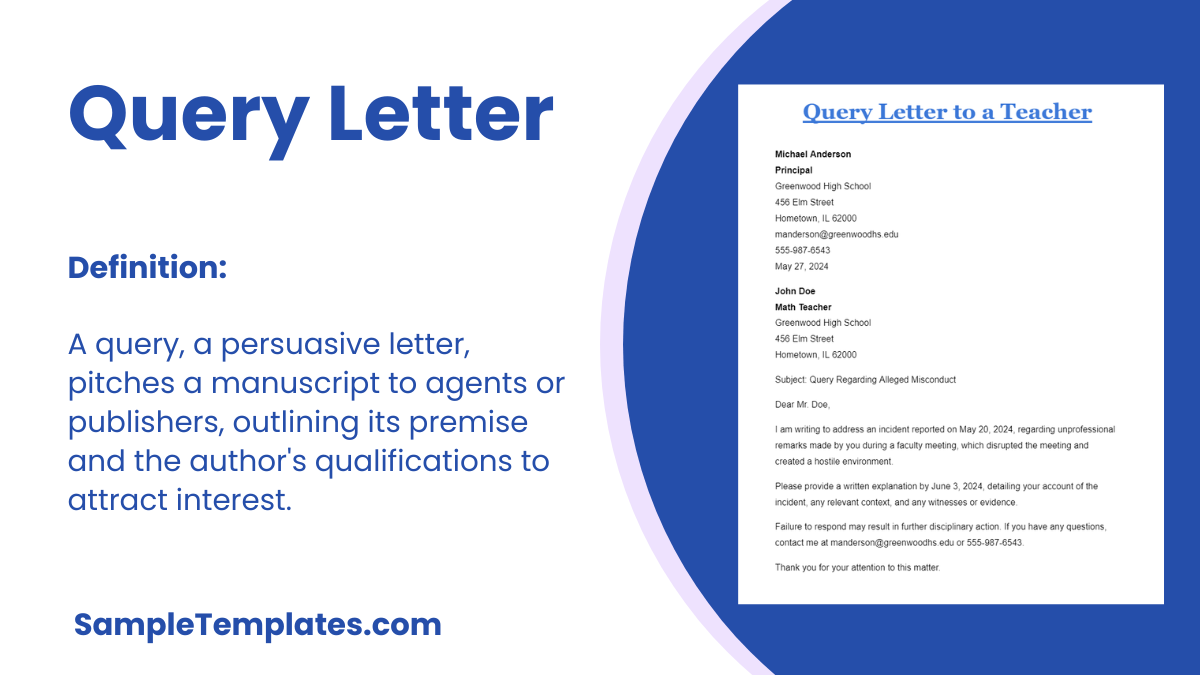
A query letter is often your first introduction to a literary agent. In just a few paragraphs, you need to communicate what your book is about, why it might fit the agent’s list, and why you are the right person to write it.
The goal isn’t to tell the agent everything about your manuscript. It’s to make the right agent curious enough to read your sample pages.
Learning how to write a query letter is an important step for writers pursuing traditional publishing. Even a strong manuscript can struggle to attract attention if its pitch is confusing, its genre is unclear, or its opening paragraph takes too long to reach the story.
The good news is that query letters follow a relatively simple structure. With a compelling hook, a focused book description, relevant author information, and careful research, you can create a professional letter that represents your work effectively.
What Is a Query Letter?
A query letter is a short professional pitch sent to a literary agent to ask whether they would consider representing your book. It introduces the manuscript, summarizes its central conflict, and provides relevant information about you as the author.
In traditional publishing, literary agents often help authors sell their work to publishers, negotiate contracts, and navigate the publishing process. Many agents receive more submissions than they can accept, so a query letter helps them decide which manuscripts deserve a closer look.
Query letter vs. synopsis vs. book proposal
Introduces your book and encourages an agent to request pages or additional materials.
Summarizes the story’s major events and usually reveals the ending, depending on the requested format.
Explains the book’s concept, audience, market position, and other details. It is especially common in nonfiction publishing.
Show the agent your actual writing, usually the opening pages or chapters specified in the submission guidelines.
Agents’ requirements differ. Some want a query letter and the first five pages; others ask for a synopsis, a full proposal, or a different combination of materials. Always follow the instructions on the agent’s official submission page.
The Standard Query Letter Format
Most fiction query letters work well at around 250–400 words, although there is no universal word limit. The best length is the shortest one that clearly communicates the book’s premise, stakes, and appeal.
1. Start with a personalized greeting
Address the agent by name and spell it correctly. If the agent has specified a preferred name or title, follow that preference.
When appropriate, mention a specific reason you chose the agent, such as a genre they represent or a manuscript they have publicly said they want. Keep this brief and genuine.
2. Introduce your book
State your manuscript’s title, category, genre, approximate word count, and relevant positioning. For example:
I’m seeking representation for The Last Orchard, an 82,000-word adult upmarket novel about a family farm facing an unexpected inheritance dispute.
Use the category and genre that accurately describe the book. Adult fiction, young adult (YA), middle grade, and picture books are not interchangeable categories. For nonfiction, explain the subject and the book’s central promise.
3. Write the story pitch
This is usually the heart of the letter. Introduce the protagonist, their goal, the main obstacle, and what is at stake if they fail. Make the premise distinctive without trying to summarize every subplot.
4. Add relevant author credentials
Include publication credits, professional expertise, research experience, or personal knowledge that directly strengthens your case for this particular book. If you are a debut author without major credits, you can keep this section short.
5. Close professionally
Thank the agent for their consideration and mention any materials included, if appropriate. Use a simple sign-off and provide the contact information requested by the agent or submission form.
How to Write a Query Letter Hook That Gets Attention
Your hook is the opening idea that makes the agent want to know more. It doesn’t need to be dramatic or mysterious. It needs to communicate what makes the book compelling.
A useful hook often combines three elements:
- A protagonist: Who is the story about?
- A problem or desire: What do they want, need, or fear?
- A distinctive complication: What makes achieving their goal difficult?
Example: A vague hook vs. a specific hook
My novel is an emotional story about love, friendship, and finding yourself during difficult times.
When a struggling violinist discovers that her late mentor left her a priceless instrument with one condition attached, she must choose between saving her family’s music school and exposing the secret that could destroy its reputation.
The second version gives the reader a protagonist, a decision, competing priorities, and consequences. It also raises questions that encourage the agent to continue reading.
Questions to improve your hook
- Can a reader identify the protagonist quickly?
- Is the central problem concrete rather than abstract?
- Does the hook distinguish this book from a generic story in the same genre?
- Does it avoid revealing too much of the ending?
- Can you explain the premise in one or two clear sentences?
How to Pitch Your Book Without Summarizing Everything
One of the most common query letter mistakes is trying to squeeze an entire novel into a few paragraphs. A pitch should highlight the main narrative engine, not provide a chapter-by-chapter account.
For fiction, build the pitch around the character’s objective, the obstacle, the stakes, and the difficult choice that drives the story forward.
A simple pitch framework
- Character: Introduce the protagonist and their situation.
- Goal: Explain what the protagonist wants or must accomplish.
- Conflict: Show what stands in the way.
- Stakes: Explain what could be lost.
- Dilemma: Reveal the difficult choice or complication that makes the story distinctive.
You do not need a separate sentence for every element. The framework is a planning tool, not a rigid formula.
What about nonfiction query letters?
Nonfiction queries often focus less on a narrative plot and more on the book’s central idea, intended readership, author expertise, and market opportunity. Depending on the subject and publisher, an agent may expect a full book proposal rather than a traditional fiction-style pitch.
For a nonfiction book, consider explaining:
- The problem or question the book addresses.
- Who the intended readers are.
- What readers will gain from the book.
- Why you are qualified to write it.
- How the book differs from existing titles serving a similar audience.
How to choose comparable titles
Comparable titles, often called comps, can help an agent understand your book’s audience and market position. Choose recent, relevant books that share meaningful characteristics with your manuscript, rather than simply naming bestsellers.
Two well-chosen comparisons are often more useful than a long list. Explain the connection briefly when necessary, and avoid suggesting that your debut is guaranteed to become the next global phenomenon.
Some agents appreciate comps in the query itself, while others prioritize the pitch. Include them when they help communicate your book’s positioning or when the submission guidelines request them.
How to Personalize a Query Letter for Each Literary Agent
A personalized query demonstrates that you have researched the agent and believe your book fits their interests. It does not require a long introduction about the agent’s career.
Useful reasons to query a particular agent include:
- The agent represents your genre and category.
- Their official wish list mentions a theme or type of story that appears in your manuscript.
- You heard them speak at a relevant conference or publishing event.
- You read an interview or submission note that genuinely relates to your book.
- The agency’s guidelines indicate that the agent is open to your type of submission.
Example personalization:
I’m querying you because your interest in character-driven speculative fiction and stories about complicated family relationships makes you a potential fit for my novel.
Avoid pretending to know an agent personally, praising their entire career in generic terms, or claiming that your book perfectly matches their list without a clear reason. If you cannot find a meaningful point of connection, a concise professional greeting is better than forced flattery.
Complete Query Letter Example for a Novel
The following fictional query letter illustrates how the different sections can work together. The title, premise, author details, and agent reference are invented for demonstration purposes.
Dear Ms. Morgan,
I’m seeking representation for The Last Orchard, an 82,000-word adult upmarket novel about family loyalty, inheritance, and the cost of preserving a fading legacy. I’m querying you because of your interest in character-driven fiction with complex family dynamics.
When thirty-year-old Elena Reyes returns to her hometown to settle her grandmother’s estate, she expects to sell the failing orchard and return to the city. Instead, she discovers that the property has been left to her and her estranged brother under a condition neither can ignore: they must keep the farm operating for one final harvest before either can claim their inheritance.
Elena needs the money to rescue her struggling design business, while her brother believes the orchard is the only thing holding their family together. As an unexpected buyer begins pressuring them to sell, Elena uncovers records suggesting that the land’s history is not what her grandmother claimed. Revealing the truth could destroy her brother’s hopes, but keeping it hidden may cost them both more than the inheritance is worth.
[Add a brief, truthful author bio here, including relevant publications, professional experience, or other credentials if applicable.]
Thank you for your time and consideration. I would be happy to send the requested sample pages or additional materials.
Best regards,
[Your Name]
[Your Email Address]
Replace the fictional details and bracketed placeholders before using this example.
Why this example works
- It identifies the book: The title, word count, category, and genre are clear.
- It introduces a protagonist: Elena has a recognizable goal and a personal reason to pursue it.
- It presents a central conflict: The inheritance condition forces the siblings to cooperate.
- It raises the stakes: Money, family relationships, and a hidden truth are at risk.
- It stays focused: The pitch avoids introducing every character or explaining the complete ending.
This example is a starting point, not a template every writer must follow. A literary thriller, fantasy novel, romance, memoir, and practical nonfiction book may need different emphasis.
What Should You Include in Your Author Bio?
Your author bio should be relevant, accurate, and brief. It is not necessary to have a long list of awards or a large social media following to query literary agents.
Depending on the book, you might mention:
- Previous publications or writing awards.
- Professional experience related to the subject.
- Research or lived experience that supports the book.
- A relevant academic background or specialist qualification.
- For nonfiction, an established audience or platform when relevant to the proposal.
I’m a registered architect whose work focuses on historic preservation. My essays on urban design have appeared in regional publications, and I volunteer with a local heritage organization.
If you are a debut novelist without publication credits, you can simply say that you are a debut author if it is useful, or move directly to the closing. Never invent credentials, exaggerate sales figures, or include personal information that does not strengthen the submission.
Common Query Letter Mistakes to Avoid
1. Writing a synopsis instead of a pitch
Too many plot events make a query difficult to follow. Concentrate on the central conflict and the choices that make the story interesting.
2. Using vague, exaggerated language
Claims such as “the most important novel of the decade” do not help an agent evaluate the manuscript. Let the premise and writing demonstrate its appeal.
3. Hiding essential book details
Agents should not have to guess whether you are querying adult fiction, young adult fantasy, a memoir, or a business book. Make the category, genre, and approximate word count easy to find.
4. Sending the same letter to every agent
You can reuse a strong core pitch, but check that each agent represents your category and accepts your genre. Adjust the greeting and personalization, and follow each agency’s exact submission instructions.
5. Ignoring manuscript readiness
For most fiction submissions, complete and carefully revised manuscript pages should be ready before you begin querying. A polished letter cannot compensate for opening chapters that are not ready to represent the book.
6. Overexplaining your inspiration
The personal story behind your book may matter, especially for memoir or certain nonfiction projects, but it should not crowd out the book’s premise and appeal.
7. Failing to proofread
Typos, an incorrect agent name, inconsistent word counts, and broken formatting can distract from your pitch. Read the final letter aloud and check every detail before sending it.
8. Ignoring submission guidelines
Some agents accept queries through email; others use submission forms or agency portals. They may request specific sample pages, a synopsis, or additional materials. Do not send attachments or links unless permitted.
9. Treating silence as a guaranteed rejection
Response times and policies vary. Check the agency’s stated timeline and follow-up rules before contacting an agent again. Some agencies consider no response after a stated period to be a pass.
How to Submit Your Query Letter Strategically
A thoughtful submission process helps you stay organized and make decisions based on evidence rather than anxiety.
- Finish and revise your manuscript. Confirm that the work is ready and that the opening pages represent its quality.
- Research suitable agents. Look at official agency websites, recent announcements, and reliable agent directories.
- Check current submission status. Confirm that the agent is open to queries and accepts your category and genre.
- Prepare the requested materials. Format the query, sample pages, synopsis, or proposal as specified.
- Submit carefully. Verify the recipient, file format, word count, and personalization.
- Track each submission. Record the date, agent, materials sent, stated response time, and outcome.
- Review your approach when appropriate. If you receive repeated passes, assess whether your query, opening pages, or agent targeting could be improved.
There is no guaranteed number of queries that will produce an offer. A good process helps you identify suitable agents, avoid preventable mistakes, and learn from the responses you receive.
Interactive Query Letter Checklist
Before sending your literary agent query, use this checklist to confirm that the key elements are ready.
0 of 8 items completed
Frequently Asked Questions About Query Letters
How long should a query letter be?
Many fiction query letters fall around 250–400 words, but this is a guideline rather than a strict rule. Follow the agent’s instructions and prioritize clarity over an exact word count.
Can I query literary agents before my novel is finished?
For most fiction, agents expect a completed and revised manuscript before you query. Nonfiction proposals can work differently, and some nonfiction projects may be pitched before the full manuscript is written. Check the agent’s requirements for your category.
Should I include comparable titles in my query letter?
Comparable titles can help communicate a book’s audience and market position. Include a small number of relevant comparisons when useful or requested, but do not let them overwhelm the central pitch.
Should I reveal the ending in a query letter?
For most fiction queries, focus on the central setup, conflict, and stakes without revealing the full ending. A synopsis is different and commonly includes the ending. Follow any specific instructions from the agent.
Can I use AI to improve my query letter?
AI tools can help identify unclear sentences, repetition, grammar issues, or a pitch that takes too long to reach the conflict. However, you should verify every detail and preserve your own voice. Never let a tool invent credentials, plot points, awards, or agent-specific claims.
How long should I wait for a literary agent to respond?
Response times vary widely by agent and agency. Consult the current submission guidelines, track the date you queried, and follow any stated follow-up policy. Avoid repeated messages outside the agency’s rules.
Should I send my query to multiple agents at once?
Many writers query multiple agents in batches, but policies and personal preferences differ. Check whether an agent requires an exclusive submission, and never offer an exclusive without understanding its terms and duration.
What if I have no publishing credits?
You can still query. Keep the bio brief, mention relevant experience if you have it, and focus on the strength of the book concept and sample pages. Do not invent credentials to fill the space.
What should I do if I receive a rejection?
Thank the agent if a reply invites a response, then continue following your submission plan. If the agent offers specific feedback, consider it thoughtfully, but remember that a rejection may reflect taste, list needs, timing, or other factors rather than a definitive judgment of your writing.
Final Tips for Writing a Query Letter That Gets Responses
A strong query letter makes it easy for a literary agent to understand what your book is, who it is for, and why its premise deserves attention. It is concise without being cryptic, specific without explaining every plot point, and professional without sounding impersonal.
Before submitting, focus on three priorities: a clear and distinctive pitch, appropriate agent research, and a manuscript that is ready for professional consideration. You cannot control an agent’s taste or workload, but you can make your submission as clear, accurate, and compelling as possible.
Write the first version without overthinking every sentence. Then revise for clarity, remove unnecessary background, verify the details, and read the letter from the perspective of someone encountering your book for the first time.